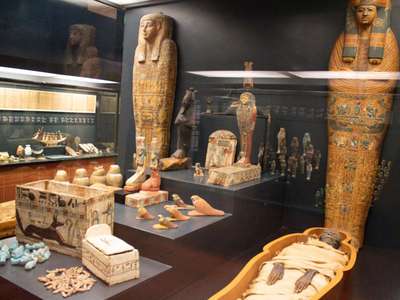
Vatican Museums Archaeological Treasures Private Guided Tour
Some images and videos on this page capture real moments from our tours, taken with guests' consent. All content is © 2025 - 2026 Archeo Tours or used under license. Unauthorized reproduction is prohibited.
Short Description
Explore the Vatican’s ancient archaeological treasures on a private tour. Discover Roman sculptures, Greek statues, mosaics, and bronze statues, with expert commentary on their historical and cultural significance.
Tour Features
Local Guide
Certified Official Guide
Tour Languages
English, Italian, Spanish, French, German
Duration
3-4 hours
Skip-the-Line
And save time
Experience Type
Private
Pickup from
Airport, Port, Hotel
Itinerary
-
The visit begins with the colossal figure of Tuia, mother of Ramses II. The frontal pose and the monumentality of the statue carry her rank.
-
-
-
-
-
-
-
-
-
-
Tour Details
Full Description
The Vatican's collections hold one of the world's great assemblies of ancient art, and this private tour follows that thread from Egypt to Rome. With an archaeologist as guide, the visit is a reading of objects rather than a walk through galleries, starting in the Gregorian Egyptian Museum with the colossal figure of Tuia, mother of Ramses II.
The route then turns to faces. In the Chiaramonti Gallery a few Roman portraits, compared side by side, show how age, hairstyle, and expression were handled; in the Braccio Nuovo the Augustus of Prima Porta stands near the Doryphoros of Polykleitos, with the cuirass that shows the Parthian king returning the Roman standards.
The Octagonal Courtyard gathers the Belvedere marbles: the Apollo, whose pose follows the movement from the supporting leg to the outstretched arm and the turned head, and the Laocoön, where changing our point of view traces the snakes between the Trojan priest and his sons. In the Hall of the Muses the Belvedere Torso shows how a twist of the body implies the whole figure, and the Round Hall adds the gilded bronze Hercules, where light and colossal scale work differently than in marble.
Two more stops widen the range: the porphyry sarcophagi of Helena and Constantia, one carved with military scenes and the other with vine tendrils and figures at the vintage, and the Gregorian Etruscan Museum, where the bronze Mars of Todi carries a dedication in Umbrian written in Etruscan letters. The visit closes in the Gregorian Profane Museum with the Marsyas and the Chiaramonti portrait of Julius Caesar.
Reviews
Be the first to leave a review.
Photos and Videos
- Archeology(181)
Colosseum Forums Palatine and Capitoline Tour with Phd Archeologist
Duration: 3-5 hoursExperience Type: PrivateStarting at
€ 145 per person -
- Archeology(151)
Ancient Pompeii Skip-the-Line Private Tour with Phd Archeologist
Duration: 2 hoursExperience Type: PrivateStarting at
€ 155 per person -
- Archeology(38)
Ostia Antica Skip-the-Line Private Tour with Phd Archeologist
Duration: 3-5 hoursExperience Type: PrivateStarting at
€ 105 per person -


Got questions? We're at your service.
We're a group of Italian professionals ready to assist you with your amazing trip. Reach out to us using any of the channels below.